
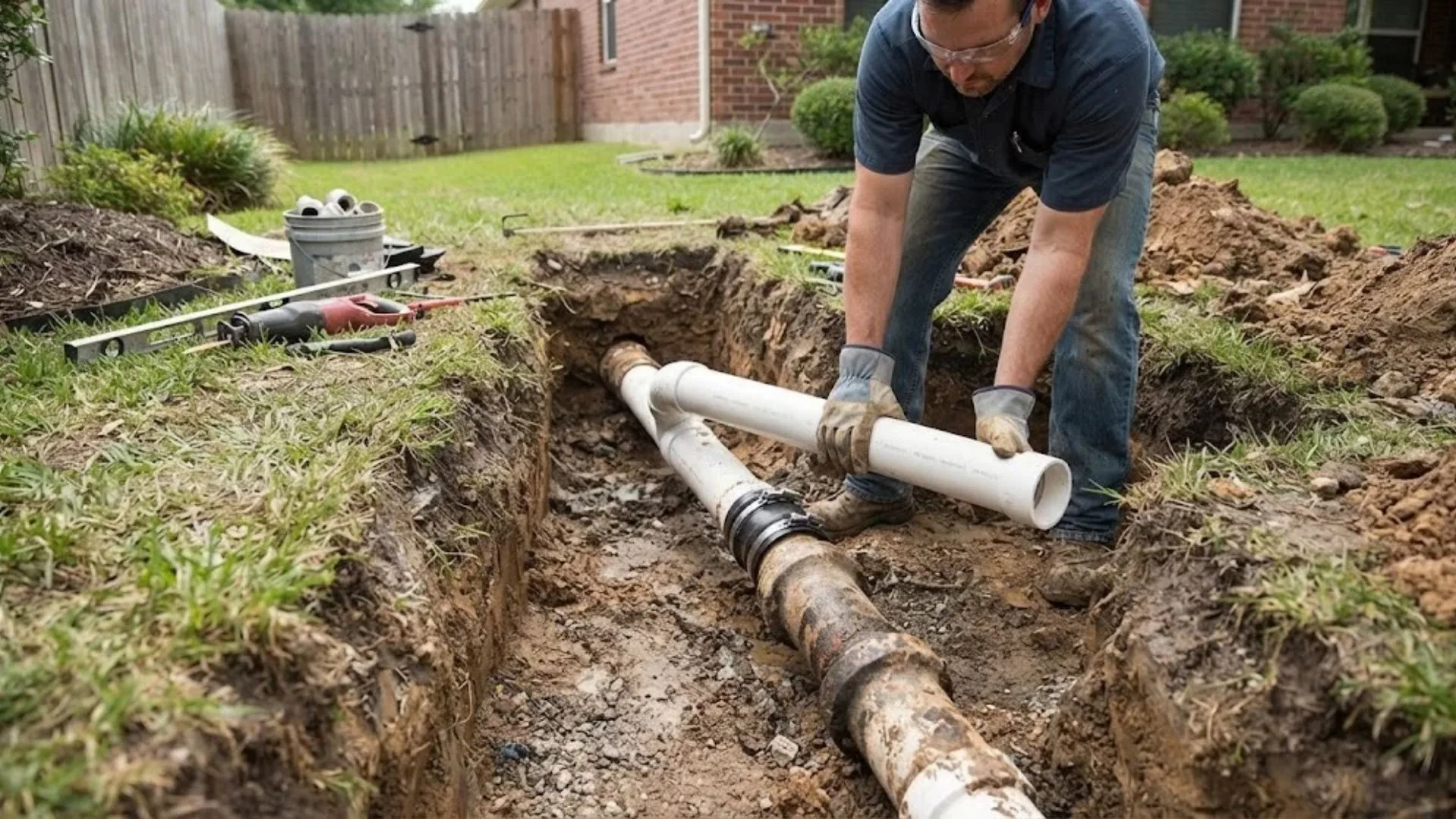
What lining is
A resin-soaked liner is pulled into the old pipe and inflated. The resin hardens and forms a new pipe inside the old one. It seals cracks, gaps at joints and root entry points, and it leaves a smooth surface.
The liner reduces the pipe diameter slightly, but the smooth surface usually carries flow as well as the old rough pipe did. Lining is one form of trenchless repair, which means little or no trenching.
What decides the price
Lining is priced by scope, not by a flat rate. These factors move the number.
| Factor | Why it matters | Direction |
|---|---|---|
| Length of the run | More liner and more time | Longer costs more. |
| Pipe diameter | Larger pipes need larger liners | Larger costs more. |
| Cleaning first | The pipe must be clean for the liner to bond | Heavy buildup adds cost. |
| Number of access points | Cleanouts or small excavations are needed | More access costs more. |
| Bends and connections | Tight turns and branches complicate the install | More complex costs more. |
| Permit and inspection | Rules vary by jurisdiction | Adds a fee. |
Because the cost depends on a camera inspection, the first step is usually a sewer camera inspection.
When lining works well
Lining suits pipes that are cracked, leaking at joints or invaded by roots but still hold their basic shape.
- Long, straight runs under driveways, patios or landscaping.
- Pipe with root entry at joints.
- Cast iron or clay with cracks but no collapse.
- Lines where digging would be expensive or disruptive.
Wondering if your line can be lined?
Call us with the symptoms and any past camera footage. We will tell you what the next step is.
Call (480) 741-9332When lining will not work
A liner needs a pipe that is open and roughly round. Some pipes cannot be lined.
- A collapsed pipe that the liner cannot pass.
- A severe belly that holds standing water, because the liner follows the sag.
- A badly offset joint that blocks the liner.
- A pipe with a very small diameter or many tight bends.
In those cases, excavation or pipe bursting is the right fix. See sewer line repair for the options.
Compare lining, bursting and digging
A short comparison helps frame the choice.
| Method | Disruption | Works best |
|---|---|---|
| Epoxy lining | Low | Sound pipe shape with leaks or roots. |
| Pipe bursting | Moderate | Collapsed or badly damaged pipe in a straight line. |
| Excavation | High | Short runs, belly or severe offset. |
Before you sign
Ask to see the camera footage that justifies lining. Ask what happens to branch connections and how the plumber will reopen them. Ask for the warranty in writing and for the permit plan. A clear answer to each question is a sign of a well-planned job.
How the lining process unfolds
A lining job follows a defined sequence, and each stage affects the cost.
- Inspect.A camera records the pipe and finds the damage.
- Clean.Hydro jetting or cutting removes roots, scale and grease.
- Install the liner.A resin-soaked liner is pulled into place and inflated.
- Cure.The resin hardens with heat, steam or light.
- Reinstate and verify.Branch openings are cut open and a final camera run confirms the result.
Cleaning is not optional. A liner will not bond to a coated wall.
Questions about longevity and resale
Buyers and lenders sometimes ask for records on sewer work. Keep the camera footage from before and after, the warranty and any permit paperwork with your house file.
A lined pipe is not invisible to an inspector. Many accept it as a documented repair. A written record answers questions quickly and may help a sale. Ask the installer what documents they provide at the end of the job.
Comparing quotes fairly
Two quotes for lining can differ by a wide margin for good reasons. One may include cleaning, reinstatement of branches, permits and a final camera run. Another may leave out several of those.
- Ask for the length of liner in feet.
- Ask for the liner thickness and material.
- Ask whether cleaning and reinstatement are included.
- Ask whether the quote covers permit fees.
- Ask for the warranty term and what it covers.
What a camera shows before lining starts
A before-and-after camera record is your proof of the work. The first pass shows cracks, roots and sags. The second shows a smooth, continuous liner and clean branch openings.
If the camera shows a collapse partway down the run, a liner cannot pass it. Better to learn that before the crew mobilizes. That is why the camera visit comes first and the quote comes second.
Local note: older lines near the Florence Townsite
The Florence Townsite Historic District was listed on the National Register of Historic Places on October 26, 1982, and includes more than 25 buildings. Lines serving older properties near the center of town may be older materials, which is exactly where a camera inspection pays off before any lining decision.
Before lining, ask the Town of Florence Community Development Department at 520-868-7575 whether a permit applies. Its web page does not state plumbing permit rules, so confirm with staff.
Camera visits to scope a lining job are available in San Tan Valley and Coolidge.
Source type: National Register of Historic Places listing for the Florence Townsite Historic District and Town of Florence contact information. The listing date is given according to the National Register record.
Questions readers ask
Manufacturers describe long service lives, but results depend on the pipe and the installation. Ask for a written warranty.
It shrinks the diameter slightly, but the smooth surface usually carries flow well.
The liner seals joints and cracks, which blocks the usual entry points.
Older lines may be clay or cast iron. A camera inspection shows the condition first.