
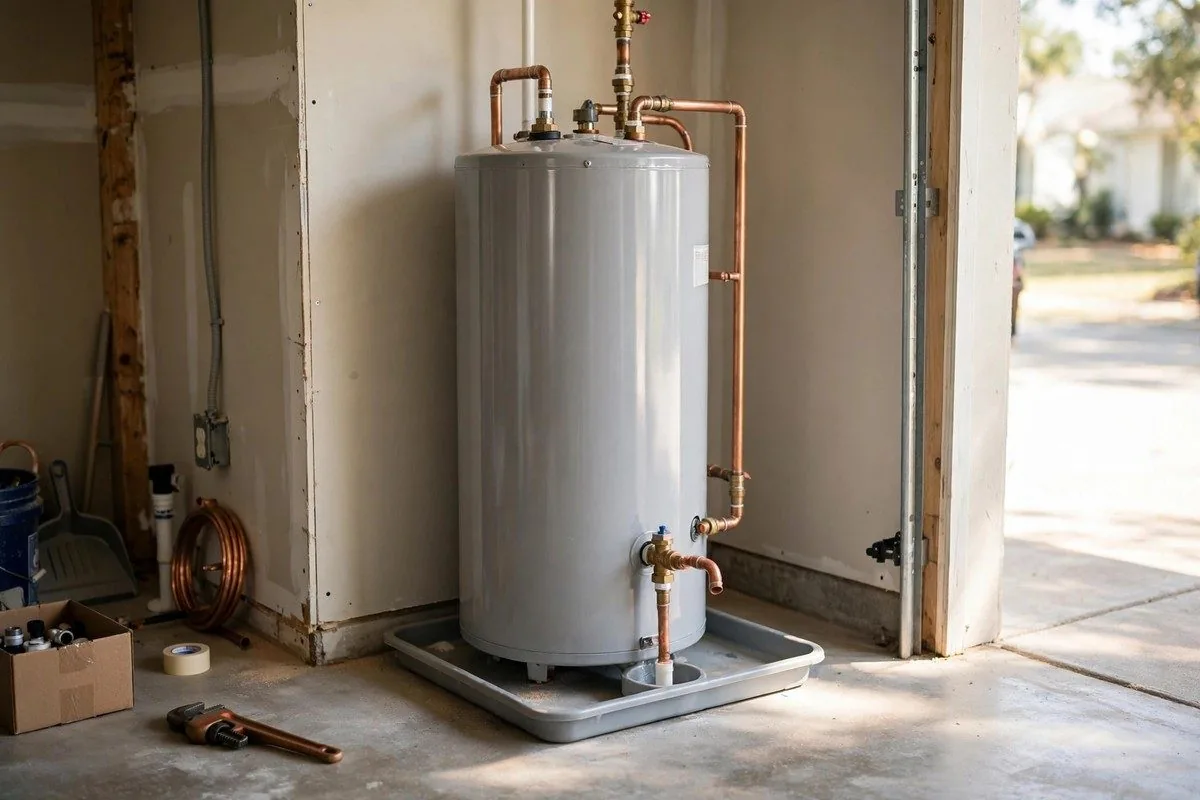
Signs your water heater is near the end
Tank heaters wear out from the inside. Watch for these signs.
- Rust-colored hot water from the taps.
- Rumbling or popping from the tank, which suggests sediment.
- Moisture or a puddle around the base of the tank.
- Hot water that runs out faster than it used to.
- A tank that is old enough that its warranty has expired.
A leak from the tank body cannot be repaired. If the leak is at a fitting, water heater repair may solve it.
Repair or replace?
The choice depends on the age of the unit and the nature of the fault.
| Situation | Usual choice | Why |
|---|---|---|
| Failed element or thermostat on a younger tank | Repair | A small part fixes it. |
| Leak from the tank body | Replace | The tank cannot be patched. |
| Old tank with repeated repairs | Replace | Repairs keep adding up. |
| Heavy sediment on an old tank | Replace | Flushing rarely restores it. |
When replacement is the answer, water heater replacement covers the process.
Sizing a new heater
A heater that is too small runs out. One that is too large wastes energy. Size by the number of people and the peak demand.
- Count bathrooms, showers and the dishwasher and laundry habits.
- Check the first hour rating on the new tank, which describes how much hot water it delivers in a busy hour.
- Fit matters too. A taller tank may not fit the closet or garage space.
- Choose fuel to match your existing lines, since changing from gas to electric or the reverse costs more.
Water heater failing today?
Call the 24/7 line. Tell us the fuel type, the tank size and what you see, and we will book the visit.
Call (480) 741-9332What happens on replacement day
A typical visit follows a clear order.
- Shut off power and water.The fuel, the electric supply and the cold line are closed.
- Drain the old tank.A hose carries the water to a safe drain.
- Disconnect and remove.Water lines, vent and gas or electrical connections are detached and the tank is carried out.
- Set the new tank.A new pan, flexible lines, valves and a pressure relief line are installed.
- Fill, test and explain.The tank fills, the heater is lit or powered and the plumber shows you the shutoffs.
Prepare the space
A clear path speeds the job. Move storage away from the heater, make sure the plumber can reach the unit with a dolly and tell us about steps or tight doors. Mention any past problems, such as a drain that never worked well or a vent that backdrafts.
Safety around a failing heater
A water heater stores a lot of energy and hot water. Respect that when something goes wrong.
- If you smell gas, leave the house and call the gas utility or 911 first.
- If the tank is leaking, shut off the power or gas and the cold water supply.
- Do not touch a pipe or fitting that is hot or spraying.
- If the relief valve discharges steam or hot water, keep clear and call.
A heater that rumbles, bangs or discharges from the relief line deserves a prompt visit. These are signs of pressure or sediment trouble.
Getting the most from a new heater
A few simple steps extend the life of the new unit after the install.
Flush the tank once a year to remove sediment. Check the anode rod every few years, because it corrodes first so the tank does not. Set the thermostat no higher than needed, and keep the area around the heater clear. Write the install date on the tank and keep the paperwork where you can find it.
A water softener helps in areas with hard water. See water softener and filtration for how to check your own water before you decide.
Questions to ask before you approve the job
A short set of questions makes the visit smoother.
- What is included?The price should list the heater, the labor, the parts and the disposal of the old unit.
- What warranty applies?Ask for the term on the tank and the labor.
- Is a permit needed?Ask who pulls it and when the inspection happens.
- What will you change in the plumbing?Expansion tanks, new valves and venting should be named.
Local note: who to call about your water and your permit
If you live in Coolidge, Arizona Water Company serves your water, and its office at 351 N Arizona Blvd answers questions at (520) 723-5346. Its 2025 report for the Casa Grande and Coolidge areas lists groundwater and no hardness figure, so ask about scale before choosing a heater type.
For permits, the Town of Florence Community Development Department at 224 W. 20th Street, 520-868-7575, can say what applies inside town limits. Pinal County Building Safety at 85 N Florence Street covers other addresses and, since July 1, 2026, San Tan Valley.
Replacement visits cover Coolidge and San Tan Valley along with town addresses.
Source type: Arizona Water Company contact and report, Town of Florence and Pinal County contact pages. Contact details are listed according to each office's own page.
Questions readers ask
A standard swap is usually a same-day job. A new location, new venting or new gas work takes longer.
Only if the numbers support it. Changing fuel means new lines or wiring.
An adult needs to give access and approve the work.
Pinal County Building Safety, as of July 1, 2026.