
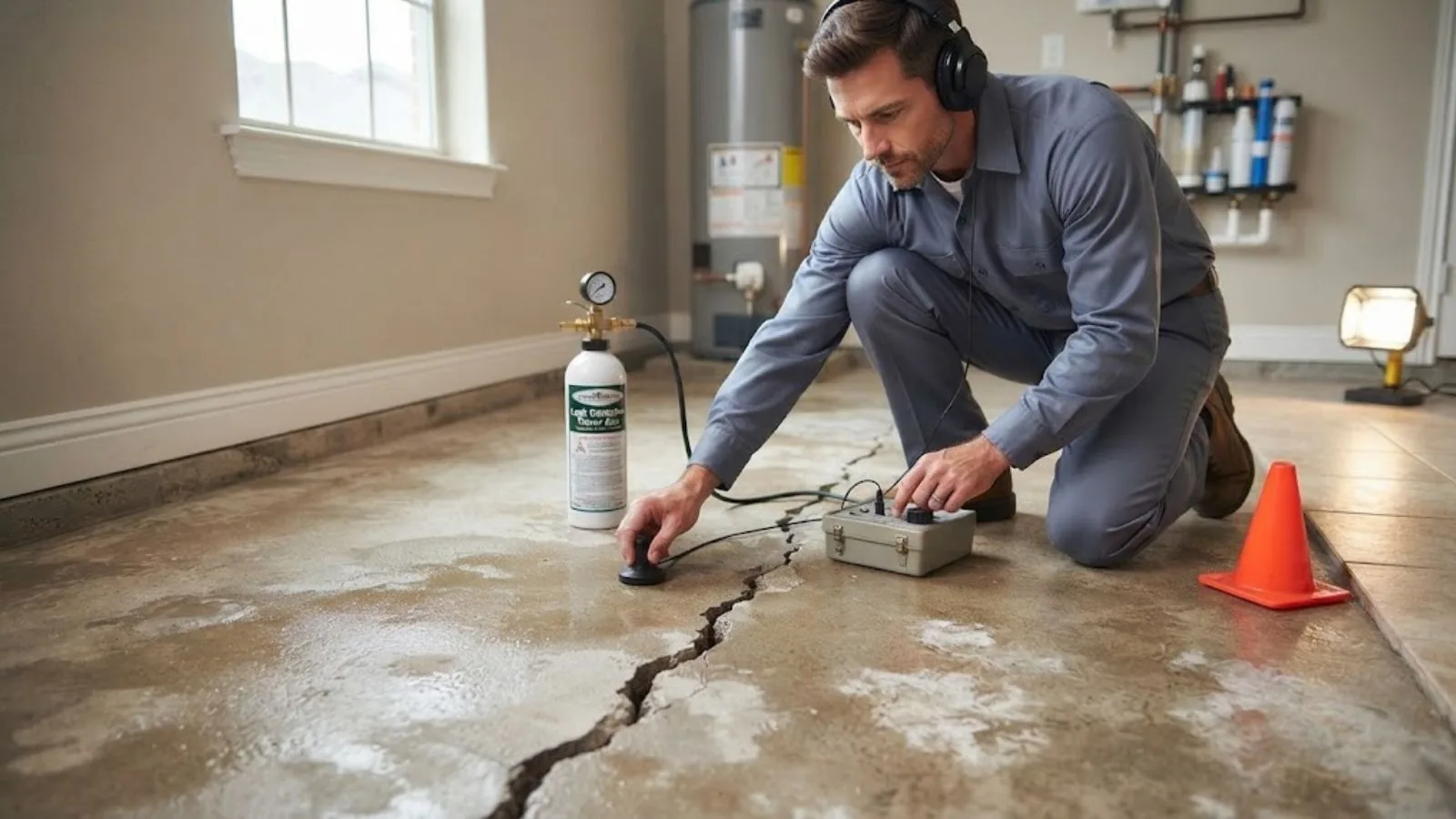
Signs of a leak under the slab
No single sign is proof, but several together are a strong clue.
- A warm or hot spot on the floor, especially in a bare room.
- A water bill that rises with no change in habits.
- The sound of running water when everything is off.
- A wet or musty patch on carpet or flooring.
- Low water pressure at some taps.
- A water meter that moves when all water use is stopped.
Confirm it with the meter
Turn off every tap and appliance. Read the meter, wait two hours with no use and read it again. A change means water is leaking somewhere on your side of the meter. Close the main valve and watch the meter again. If it stops moving, the leak is inside the house. If it keeps moving, the leak is between the meter and the house.
This test separates a slab leak from a toilet that runs silently. Check the toilets with a few drops of food coloring in each tank. If color shows in the bowl after ten minutes, that toilet leaks.
How detection tools work
Each tool answers a different question.
| Tool | What it does | Best use |
|---|---|---|
| Pressure test | Checks whether a closed system holds pressure | Confirming a leak exists. |
| Acoustic listening | Hears the sound of escaping water through the slab | Narrowing the location. |
| Thermal imaging | Shows temperature differences from a hot line leak | Hot water lines. |
| Tracer gas | Releases a harmless gas that escapes at the leak | Hard-to-hear leaks. |
| Line locator | Traces the path of buried pipe | Marking the dig point. |
A good plumber combines two or more tools before cutting concrete, because a wrong guess costs time and money.
Think you have a slab leak?
Call us with the signs you see and the meter reading. We will schedule detection and tell you what to shut off.
Call (480) 741-9332What the results tell you
Detection ends with a location and a recommendation. The leak may be at a single joint, along a stretch of pipe or in a line that is failing throughout.
A single failure can be repaired in place. Repeated failures suggest rerouting the line through the attic or walls, which avoids the slab entirely. Our slab leak repair page describes those options, and the general method is covered under leak detection.
What to do while you wait
If you suspect a slab leak, you can limit damage without waiting for a visit.
- Shut off the main water valve if a bill spike or sound suggests a large leak.
- Turn down the water heater if the leak is on a hot line.
- Move rugs, boxes and furniture off the affected floor.
- Take photos of any damp spots and the meter readings.
- Call your insurance agent before you arrange repairs.
Hot line leaks versus cold line leaks
The type of pipe that leaks changes how it shows up. A hot line leak warms the floor and is easier to see with thermal imaging. A cold line leak is cooler and quieter.
Hot water lines tend to fail sooner because heat speeds corrosion. A hot line leak also makes the water heater run more, which can raise your gas or electric bill along with your water bill. Check whether the heater seems to cycle often even when little hot water is used.
Choosing a detection company
Detection is a skill, and results vary with the operator. Ask these questions before you book.
- Ask which tools they use.A good company uses more than one method and cross-checks.
- Ask what you receive.A written finding with a marked location and photos is useful for repairs and insurance.
- Ask about access damage.Detection should not require opening the slab.
- Ask what happens next.The company should explain repair options without pressure.
Cheap detection that guesses wrong costs more than careful detection that finds the leak the first time.
Why early detection saves money
Water under a slab can soften soil, lift flooring and feed mold. The longer it runs, the more it costs. Detection is cheap compared with the damage that a long-running leak causes.
Check your meter after any vacation, and read your bill each month. A small, steady rise is easy to miss. Catching it in the first month turns a large repair into a small one.
Local note: ground movement in Pinal County
The Arizona Geological Survey reports that earth fissures exist in Pinal County. They are caused by land subsidence from groundwater pumping, and monsoon runoff can widen them. The survey advises keeping people away from a fissure, keeping runoff out of it and reporting it to the survey and local emergency management.
A fissure is not the same as a slab leak, and most slab leaks come from ordinary pipe wear. But if you see a crack opening in the ground near the house along with water loss, report the fissure and tell the plumber, because moving ground can break lines.
Detection visits are scheduled for Coolidge and San Tan Valley homes as well.
Source type: Arizona Geological Survey earth fissure information (state agency). The fissure guidance is given according to the Arizona Geological Survey.
Questions readers ask
Yes. Acoustic, thermal and pressure tools locate it before any cutting.
A warm floor spot, a moving meter with the house off and sound from the floor are the clues.
Policies vary. Many cover resulting damage, and some cover access. Ask your agent.
The Arizona Geological Survey and local emergency management.