
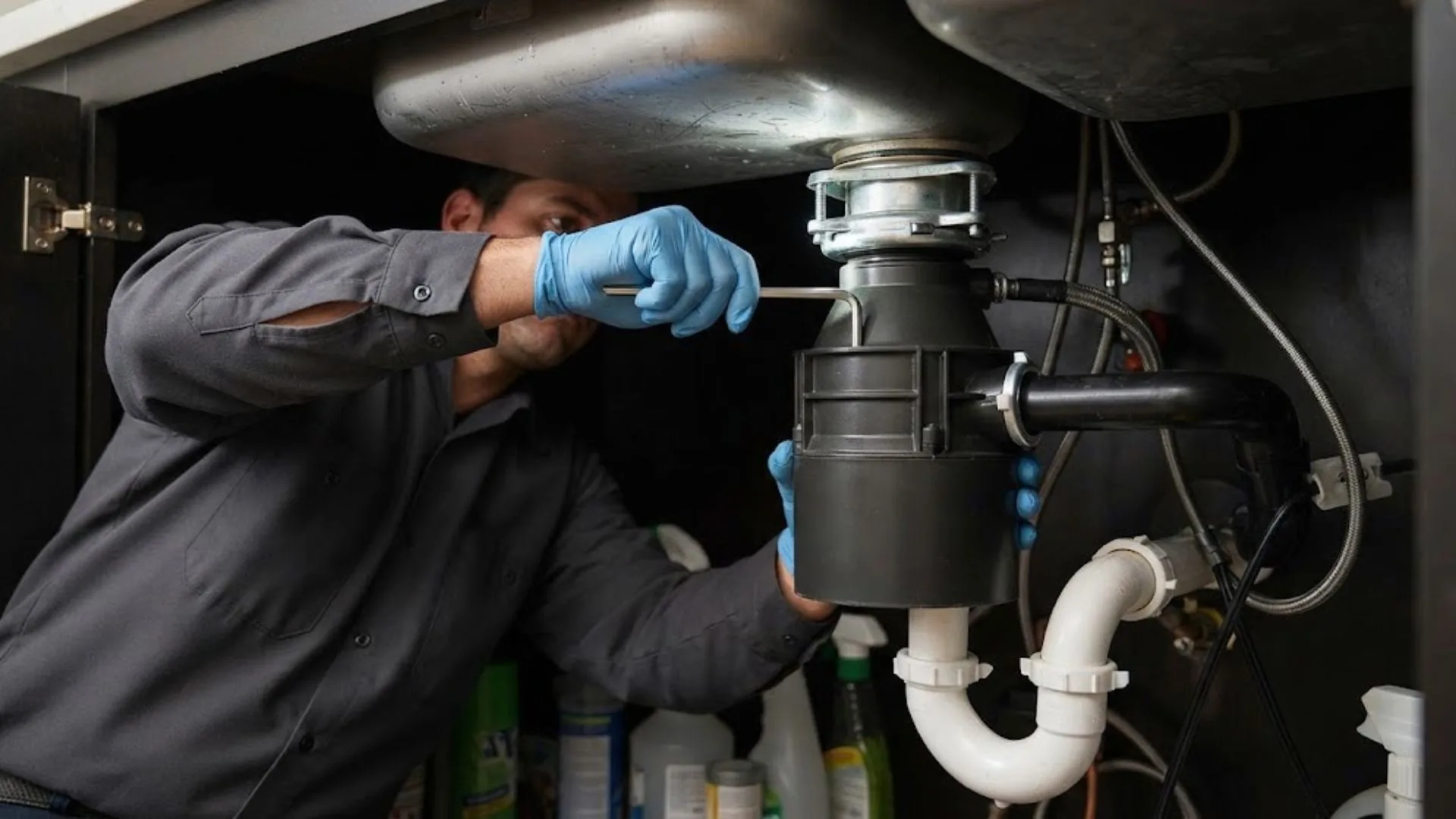
Safety first: never put a hand in the disposal
Before any troubleshooting, cut the power. Switching off the wall switch is not enough, because someone may flip it back on.
- Unplug the disposal under the sink, or turn off its breaker at the panel.
- Never reach in by hand. Use tongs or pliers to remove an object.
- Use a flashlight to look into the opening before you touch anything.
- Keep children away from the kitchen until the unit is safe again.
What the symptom tells you
The sound a disposal makes points to the cause.
| Symptom | Likely cause | First step |
|---|---|---|
| Humming, no spin | Jammed flywheel | Turn the flywheel with a hex key from below. |
| No sound, no hum | No power or tripped overload | Press the red reset button on the bottom. |
| Grinding noise | Foreign object inside | Power off and remove it with tongs. |
| Leak at the top | Failed sink flange seal | Tighten or reseal the flange. |
| Leak at the side | Loose drain connection | Tighten the connection. |
| Leak from the bottom | Cracked housing or seal | Replace the unit. |
Free a jammed disposal
Most disposals have a hex socket in the center of the bottom. Power must be off before you use it.
- Insert the hex key.Fit the wrench into the socket at the bottom of the unit.
- Work it back and forth.Turn until the flywheel moves freely in both directions.
- Remove the cause.Look inside with a flashlight and pull out any bone, utensil or bottle cap with tongs.
- Press reset.Push the red reset button on the bottom of the unit.
- Restore power and test.Run cold water, switch the disposal on briefly and listen.
If the unit trips again right away, the motor is probably failing. Continued resets can overheat it.
Disposal beyond a simple fix?
Call us with the make, the symptom and what you have tried. We will tell you whether it is a repair or a swap.
Call (480) 741-9332Leaks under the sink
A wet cabinet floor sends many people straight to a new disposal, but the leak may be somewhere cheaper to fix. Dry the area, run water and watch where it appears first.
Water at the top rim points to the sink flange. Water at the side points to the drain elbow or the dishwasher hose. Water from the bottom of the body means the housing has failed and the unit must be replaced.
Leaks that are ignored swell the cabinet floor and can feed mold. If you cannot find the source, our leak detection service can trace it.
Habits that keep a disposal running
A disposal is a small grinder, not a trash can. These habits extend its life.
- Run cold water before, during and after each use.
- Feed scraps in small amounts rather than a full load.
- Keep grease, coffee grounds in bulk, bones, pasta and rice out of the unit.
- Skip fibrous items such as celery, corn husks and potato peels.
- Grind a handful of ice now and then to knock loose residue.
Grease is the main cause of kitchen drain clogs further down the line. See drain cleaning when the sink backs up after you fix the disposal.
When replacement is the better choice
A disposal lasts several years, and the cost of a repair adds up. Replace it when the housing leaks, the motor keeps tripping or the unit is rusty and loud. Pick a motor size to match how you cook, and make sure the mounting fits your sink.
Our garbage disposal repair and replacement service covers diagnosis, removal and installation of a new unit.
Choosing a replacement disposal
If a replacement is the answer, a few specs matter more than the brand name. Match them to how you cook and to the space under your sink.
Tell the installer if you have a septic system, since some units suit septic tanks better than others.
| Spec | What it means | What to look for |
|---|---|---|
| Horsepower | Grinding power | A mid-range motor suits most families. |
| Feed type | Continuous or batch | Continuous is common, batch adds a safety lid. |
| Mount | How it attaches to the sink | Match the existing flange when possible. |
| Sound insulation | Noise level | More insulation means a quieter unit. |
| Warranty | Parts and in-home service | Longer terms signal a sturdier unit. |
Smells, slow draining and the dishwasher connection
A disposal that smells is usually dirty and not broken. Grind a few ice cubes with a halved lemon, run cold water and wipe the rubber splash guard with a brush. If the smell returns, food is trapped in the drain line past the disposal.
The dishwasher drain hose connects to a small port on the side of the disposal. A new disposal has a knockout plug in that port. Forgetting to remove the plug is a classic mistake, and it makes the dishwasher back up into the sink. If the dishwasher will not drain after an install, check that plug first.
Local note: permits and who to ask in Florence
Replacing a disposal is usually a minor job, but rules differ by jurisdiction. The Town of Florence Community Development Department is at 224 W. 20th Street, phone 520-868-7575, open Monday through Thursday from 7 a.m. to 5 p.m. Its page does not spell out plumbing permit rules, so call before you assume a permit is or is not needed.
Outside town limits, Pinal County Building Safety at 85 N Florence Street handles building permits. A quick call saves a failed inspection later.
Kitchen calls also come from Coolidge and from San Tan Valley, and the dispatcher handles them the same way.
Source type: Town of Florence Community Development contact page and Pinal County Building Safety contact information. Hours and addresses are listed according to each office's own page.
Questions readers ask
Something has jammed the flywheel. Cut the power and turn the flywheel with a hex key, then press reset.
If the leak is at the flange or a connection, tightening or resealing may work. A leak from the body means replacement.
It varies with use and unit quality. A unit that leaks, trips often or sounds rough is near the end.
The Town page does not state a rule. Call Community Development at 520-868-7575 to confirm for your address.