
Look at the bill first
Compare this bill with the same month last year and the last few months. Seasonal swings are normal, especially when irrigation runs. A jump of the size that a family would not use, with no new pool fill or visitors, deserves a test.
Also check whether the meter read was an estimate. A catch-up read after several estimates can look like a sudden jump when it is not.
The meter test
This is the most reliable test.
- Stop all use.Turn off taps, ice makers, irrigation and appliances.
- Read the meter.Write down the number and look at the leak indicator.
- Wait two hours.Do not use any water in that time.
- Read again.If the number moved, water is leaking on your side of the meter.
- Narrow it down.Close the main house valve. If the meter stops, the leak is inside the house. If it keeps moving, the leak is outside or before the valve.
The usual suspects, in order of likelihood
Start with the cheapest and most common causes.
| Source | Test | Fix |
|---|---|---|
| Toilet flapper | Add food coloring to the tank and wait ten minutes | Replace the flapper or fill valve. |
| Dripping faucet or shower | Look and listen with the house quiet | Replace the cartridge or washer. |
| Irrigation line or valve | Run the meter test with irrigation off and on | Repair the line or valve. |
| Water heater relief valve | Check the discharge pipe for wetness | Replace the valve or tank. |
| Buried supply line | Meter moves with the house valve closed | Locate and repair the line. |
Toilets are the top cause of silent household leaks. See toilet repair if the dye test shows color.
Bill jumped and you do not know why?
Call us with your meter readings. We will tell you what the numbers suggest and book detection if needed.
Call (480) 741-9332Outdoor and underground leaks
A leak between the meter and the house shows up as a moving meter with the house valve closed. Signs include a wet patch in the yard, unusually green grass or a low spot that stays soggy. These leaks can waste a lot of water for a long time.
Call 811 before anyone digs. See water line repair for how a buried supply line is located and replaced, and leak detection for how hidden leaks are found without tearing up a yard.
What to do when you cannot find it
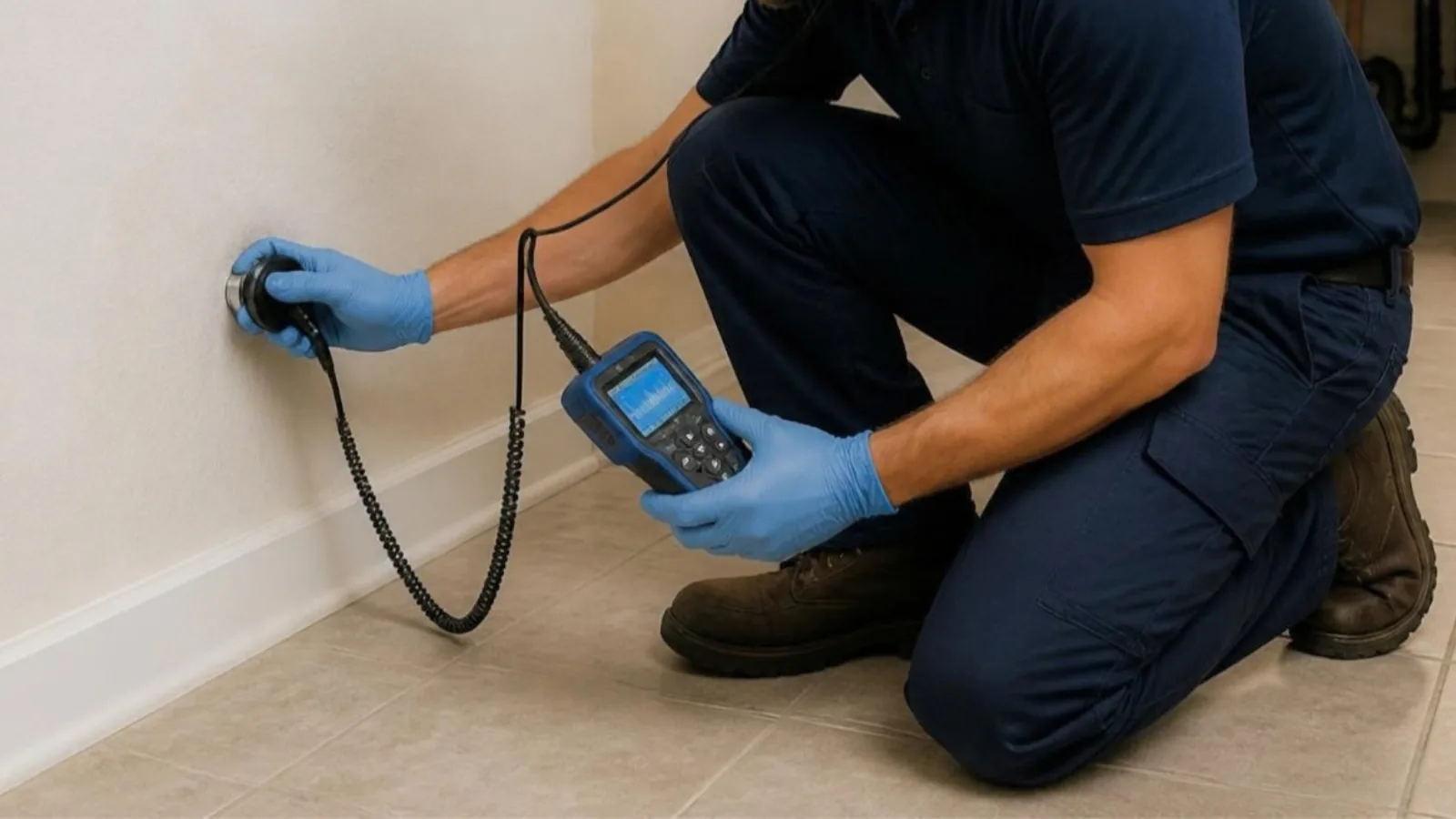
If the meter moves and you cannot find the cause, stop searching and book detection. Pressure testing, acoustic listening and thermal tools find leaks in walls and under slabs. Meanwhile, close the main valve when no one is home to limit loss.
Reading your meter like a pro
Most residential meters have a dial with a small triangle or wheel that spins when any water moves. That is the leak indicator, and it reacts to very small flows.
Look for the center of the register, which counts in fine increments. Watch it with every fixture off. If it creeps, you have a slow leak. If it turns steadily, the leak is larger. Take a photo of the meter face before and after each test so you have a record.
Keep the meter box lid clear and note any damage. If the meter itself looks cracked or the numbers are hard to read, tell your water provider.
Irrigation as a hidden bill driver
In a dry climate, irrigation can be the biggest source of water use. A stuck zone valve, a broken sprinkler head or a cracked drip line wastes a lot of water, often at night when no one sees it.
- Turn the system off at the controller.Make sure no zone runs during the test.
- Run the meter test.See whether the meter still moves.
- Run each zone by hand.Look for geysers, soggy spots and low pressure.
- Repair or call.Fix a broken head yourself or ask a landscape or plumbing pro for the rest.
A buried line between the meter and the house is a plumbing repair. See water line repair for that case.
A simple monthly habit
Read your meter on the first of each month and write the number on a calendar. The difference gives your use for the month. A sudden jump shows up weeks before the bill arrives.
That small habit catches leaks early, confirms billing is right and helps you see how irrigation and guests affect your use.
Local note: your service line and the Town of Florence
The Town of Florence is completing a lead service line inventory. Owners whose line material is unknown received a notice in November 2025. For questions, the Town lists LCR@florenceaz.gov as the contact.
That inventory is a good reason to learn what your service line is made of. If a leak test points to the line between the meter and your house, ask the plumber to note the pipe material so you can share it with the Town. WaterSense guidance from the EPA adds that fixing easy leaks can save about ten percent on a water bill.
We test and trace leaks in Coolidge and San Tan Valley too.
Source type: Town of Florence water quality page (municipal government) and EPA WaterSense. The inventory notice is described according to the Town page.
Questions readers ask
It can waste a large amount over a month. Use the dye test to check.
Usually not. The owner is responsible for the line from the meter to the house.
Yes. A stuck valve or broken line is a common cause in dry climates.
The Town lists LCR@florenceaz.gov for questions.