
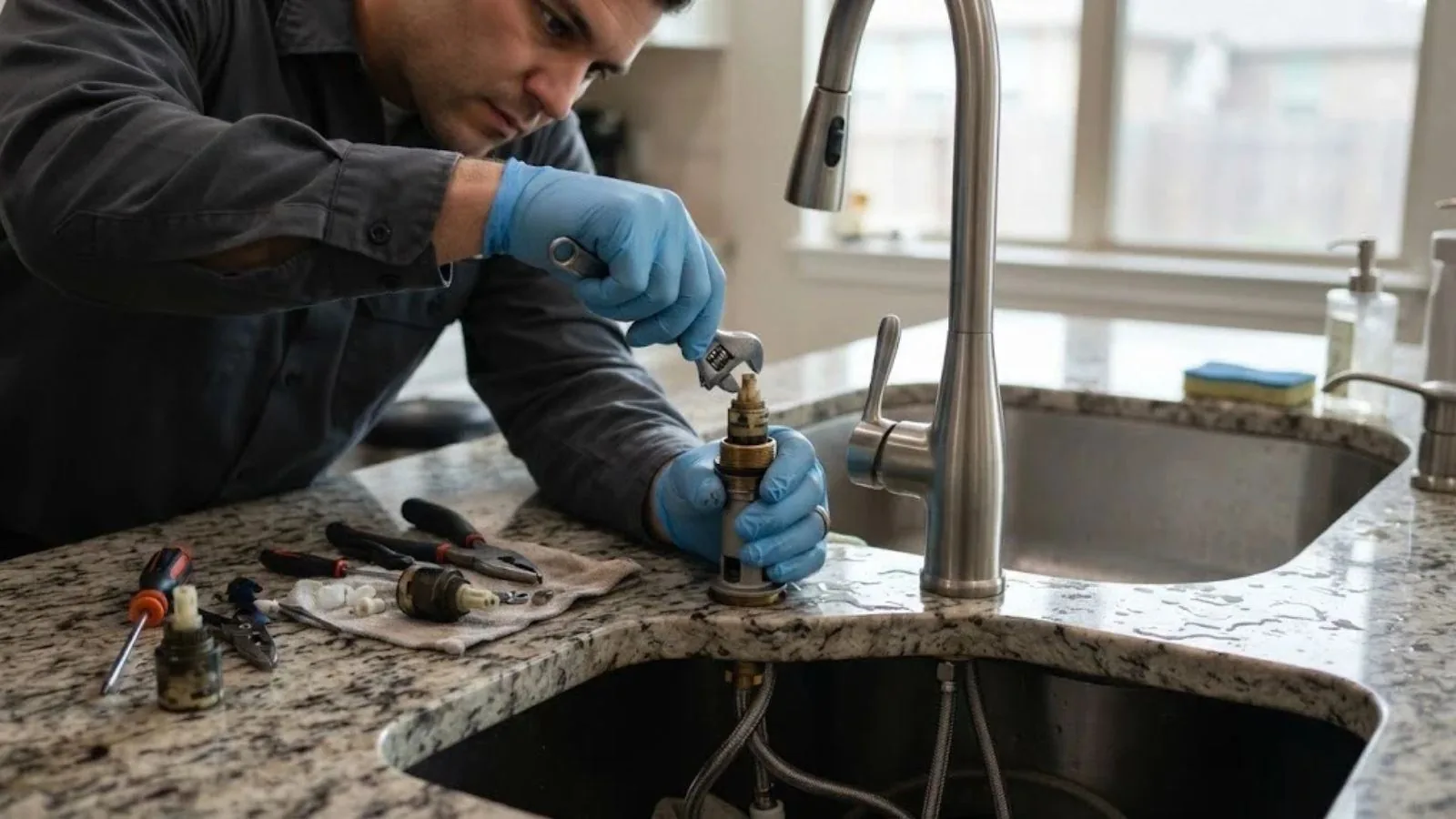
Why a faucet drips in the first place
Every faucet has a part that stops the flow when you shut it off. Over the years that part wears, hardens or collects mineral crust, and a thin stream sneaks past it.
- A worn rubber washer or seat in a compression faucet lets water seep out of the spout.
- A damaged O-ring around the stem makes water leak at the handle.
- A cracked or scaled cartridge in a single-handle faucet causes a steady drip from the spout.
- Corroded valve seats pit the surface the washer presses against, so a new washer will not seal.
The repair always starts with turning off the water to the faucet. Look under the sink for the two small shutoff valves, and turn them clockwise until they stop.
Identify your faucet type before you buy parts
Buying the wrong part is the most common reason a repair fails. Take a minute to identify the faucet.
| Faucet type | How to spot it | Usual repair |
|---|---|---|
| Compression | Two handles that turn several times | Replace washers and the seat. |
| Cartridge | One handle or two, smooth quarter-turn feel | Replace the cartridge. |
| Ball | One handle over a round cap | Replace seats, springs and the ball. |
| Ceramic disk | One handle, wide cylinder under it | Replace the disk cartridge. |
A safe repair for most single-handle faucets
This sequence works for the common cartridge style. Go slowly and keep every part in order on a towel.
- Shut off the water.Close both shutoffs under the sink and open the faucet to drain the pressure.
- Plug the drain.A rag in the drain keeps small screws from falling into the pipe.
- Remove the handle.Pry off the cap, remove the set screw and lift the handle away.
- Pull the cartridge.Take out the retaining nut or clip and lift the cartridge straight out.
- Match and replace.Take the old cartridge to the store, buy the same model and reinstall it with fresh O-rings.
- Test.Open the shutoffs slowly, run the faucet and look for drips at the spout and the base.
Faucet will not stop dripping?
Call us with the faucet type and what you have tried. We will tell you whether a repair or a replacement makes more sense.
Call (480) 741-9332When the drip is not a quick fix
Some leaks keep coming back after a good repair. That usually means the valve seat is pitted or the faucet body itself is worn. Forcing parts in a corroded faucet can crack it.
Stop and call if the handle will not come off, the water will not shut off at the stop valves, or water appears under the sink. A failing shutoff valve is a sign the supply line needs work as well. Our faucet repair service covers replacing worn faucets, seats and supply lines.
What a dripping faucet costs you each month
The Environmental Protection Agency says a faucet that drips once per second wastes more than 3,000 gallons a year. That is water you pay for and never use. A repair that costs a few dollars in parts pays itself back within a season.
If your bill has climbed and no faucet is dripping, the loss may be hidden. A running toilet or a leak in a wall can waste far more. See leak detection to find leaks you cannot see.
Tub and shower faucets drip too
The same parts live inside a tub faucet, but the repair takes more care. The valve is in the wall, and you may need a special socket to reach it. A constant drip at a shower head after the water is off means the cartridge or the diverter has failed.
When a shower faucet is old and the trim is no longer made, replacing the valve can be a bigger job. Our crew handles that kind of plumbing installation as well as simple repairs.
Tools and parts worth keeping on hand
A small kit turns a long afternoon into a short job. Most faucet repairs need only a handful of items, and none are expensive.
- An adjustable wrench and a set of hex keys for set screws.
- A flat screwdriver and a small pick for prying off caps.
- Plumber's grease for O-rings and cartridge seals.
- A pack of assorted O-rings and washers sized for common faucets.
- White vinegar and an old toothbrush for cleaning aerators and valve seats.
Take the old part with you when you shop. Faucet brands use different cartridge shapes, and a part that looks close often leaks. A photo of the faucet and the label under the sink also helps the clerk find a match.
Kitchen faucet extras: sprayers and pull-down hoses
A kitchen faucet adds parts that a bathroom faucet does not have. The sprayer head, the pull-down hose and the diverter that switches between them can each leak.
A drip from the spray head after you shut it off usually means a worn diverter or a clogged spray nozzle. Water under the sink that appears only when you use the sprayer points to a loose hose connection or a cracked hose. Tighten fittings by hand plus a quarter turn, and replace any hose that is stiff or cracked.
If the base of the faucet leaks around the deck, the mounting nut or the gasket has loosened. That repair means working under the sink with a basin wrench, which is awkward without practice.
Local note: Florence water and faucet crust
Florence Water uses four groundwater wells, according to the Town of Florence water quality information. The 2025 Consumer Confidence Report lists sodium at 110 parts per million. It does not report a hardness number, so the report alone cannot tell you how fast scale will form on your aerator.
A simple check helps. Unscrew the aerator at the end of the spout and look for white or tan crust. If it is heavy, your water leaves mineral deposits, and a faucet cartridge will wear sooner. Homeowners in Anthem at Merrill Ranch get water from a different utility, so ask yours for its report.
Neighbors in Coolidge and San Tan Valley can book the same faucet visits.
Source type: Town of Florence 2025 Consumer Confidence Report (utility water-quality report). The sodium figure is given according to the Town report.
Questions readers ask
Repair a faucet that is only worn at the cartridge or washer. Replace it when the body is corroded, parts are no longer made or the finish is failing. A plumber can tell you in a short visit.
Heat expands the rubber parts, and a worn seal can let water pass. A hot-side cartridge is the usual cause.
Yes. A steady drip wastes thousands of gallons a year, which shows up on the bill.
The Town report does not list hardness. Check your aerator for crust, and test your tap if the buildup is heavy.